
My writings - and those of others.

When we are arrogant

Any faith that thinks it has the total answer and must impose it on others is dangerous when it uses domination. For the record, here is a thanksgiving offering from First Nations People that North American Christians thought were heathen, called them savages and tried to destroy their thousands of years of faith. In a time of climate crisis. this teaching is precisely what we now need to recover and learn:
Haudenosaunee Thanksgiving Address
This Thanksgiving address was used by the six nations of the Haudenosaunee (Iroquois) to open and close major gatherings or meetings. The prayer was also sometimes used individually at the beginning or end of the day..
The People
Today we have gathered and we see that the cycles of life continue. We have been given the duty to live in balance and harmony with each other and all living things. So now, we bring our minds together as one as we give greetings and thanks to each other as people.
Now our minds are one.
The Earth Mother
We are all thankful to our Mother, the Earth, for she gives us all that we need for life. She supports our feet as we walk about upon her. It gives us joy that she continues to care for us as she has from the beginning of time. To our mother, we send greetings and thanks.
Now our minds are one.
The Waters
We give thanks to all the waters of the world for quenching our thirst and providing us with strength. Water is life. We know its power in many forms- waterfalls and rain, mists and streams, rivers and oceans. With one mind, we send greetings and thanks to the spirit of Water.
Now our minds are one.
The Fish
We turn our minds to the all the Fish life in the water. They were instructed to cleanse and purify the water. They also give themselves to us as food. We are grateful that we can still find pure water. So, we turn now to the Fish and send our greetings and thanks.
Now our minds are one.
The Plants
Now we turn toward the vast fields of Plant life. As far as the eye can see, the Plants grow, working many wonders. They sustain many life forms. With our minds gathered together, we give thanks and look forward to seeing Plant life for many generations to come.
Now our minds are one.
The Food Plants
With one mind, we turn to honor and thank all the Food Plants we harvest from the garden. Since the beginning of time, the grains, vegetables, beans and berries have helped the people survive. Many other living things draw strength from them too. We gather all the Plant Foods together as one and send them a greeting of thanks.
Now our minds are one.
The Medicine Herbs
Now we turn to all the Medicine herbs of the world. From the beginning they were instructed to take away sickness. They are always waiting and ready to heal us. We are happy there are still among us those special few who remember how to use these plants for healing. With one mind, we send greetings and thanks to the Medicines and to the keepers of the Medicines.
Now our minds are one.
The Animals
We gather our minds together to send greetings and thanks to all the Animal life in the world. They have many things to teach us as people. We are honored by them when they give up their lives so we may use their bodies as food for our people. We see them near our homes and in the deep forests. We are glad they are still here and we hope that it will always be so.
Now our minds are one.
The Trees
We now turn our thoughts to the Trees. The Earth has many families of Trees who have their own instructions and uses. Some provide us with shelter and shade, others with fruit, beauty and other useful things. Many people of the world use a Tree as a symbol of peace and strength. With one mind, we greet and thank the Tree life.
Now our minds are one.
The Birds
We put our minds together as one and thank all the Birds who move and fly about over our heads. The Creator gave them beautiful songs. Each day they remind us to enjoy and appreciate life. The Eagle was chosen to be their leader. To all the Birds-from the smallest to the largest-we send our joyful greetings and thanks.
Now our minds are one.
The Four Winds
We are all thankful to the powers we know as the Four Winds. We hear their voices in the moving air as they refresh us and purify the air we breathe. They help us to bring the change of seasons. From the four directions they come, bringing us messages and giving us strength. With one mind, we send our greetings and thanks to the Four Winds.
Now our minds are one.
Closing Words
We have now arrived at the place where we end our words. Of all the things we have named, it was not our intention to leave anything out. If something was forgotten, we leave it to each individual to send such greetings and thanks in their own way.
Now our minds are one.
Thanksgiving Address: Greetings to the Natural World English version: John Stokes and Kanawahienton (David Benedict, Turtle Clan/Mohawk) Mohawk version: Rokwaho (Dan Thompson, Wolf Clan/Mohawk) Original inspiration: Tekaronianekon (Jake Swamp, Wolf Clan/Mohawk).
Available through the Smithsonian National Museum of the American Indian.
Less Time to Spare

The Intergovernmental Panel on Climate Change (IPCC) is the United Nations body for assessing the science related to climate change. It just recently released its sixth report, which confirms that we are running out of time. The message of the IPCC report pulls no punches: “We have to raise the ambition level of mitigation for the coming COP26 meeting in Glasgow,” says Petteri Taalas, secretary-general of the World Meteorological Organization.
It’s hard to get people focused on this issue as a rule, but a summer of forest fires, floods and heat waves may help. Thomas Berry, a theologian who preferred to call himself a geologian, noted the problem in 1978 when few were paying attention. Since the last Paris conference, young activists like Greta Thunberg and the Sunrise Movement have helped spread the word.
One of the things that helps is when scientists sound confident in what they are saying. During the pandemic, for example, tentative messages have created anxiety or distrust when the detractors don’t realize that dealing with a new virus is an exploration. Generally scientific language is conservative. But this time, according to the following Time magazine chart, there is considerably more confidence in their assertions:
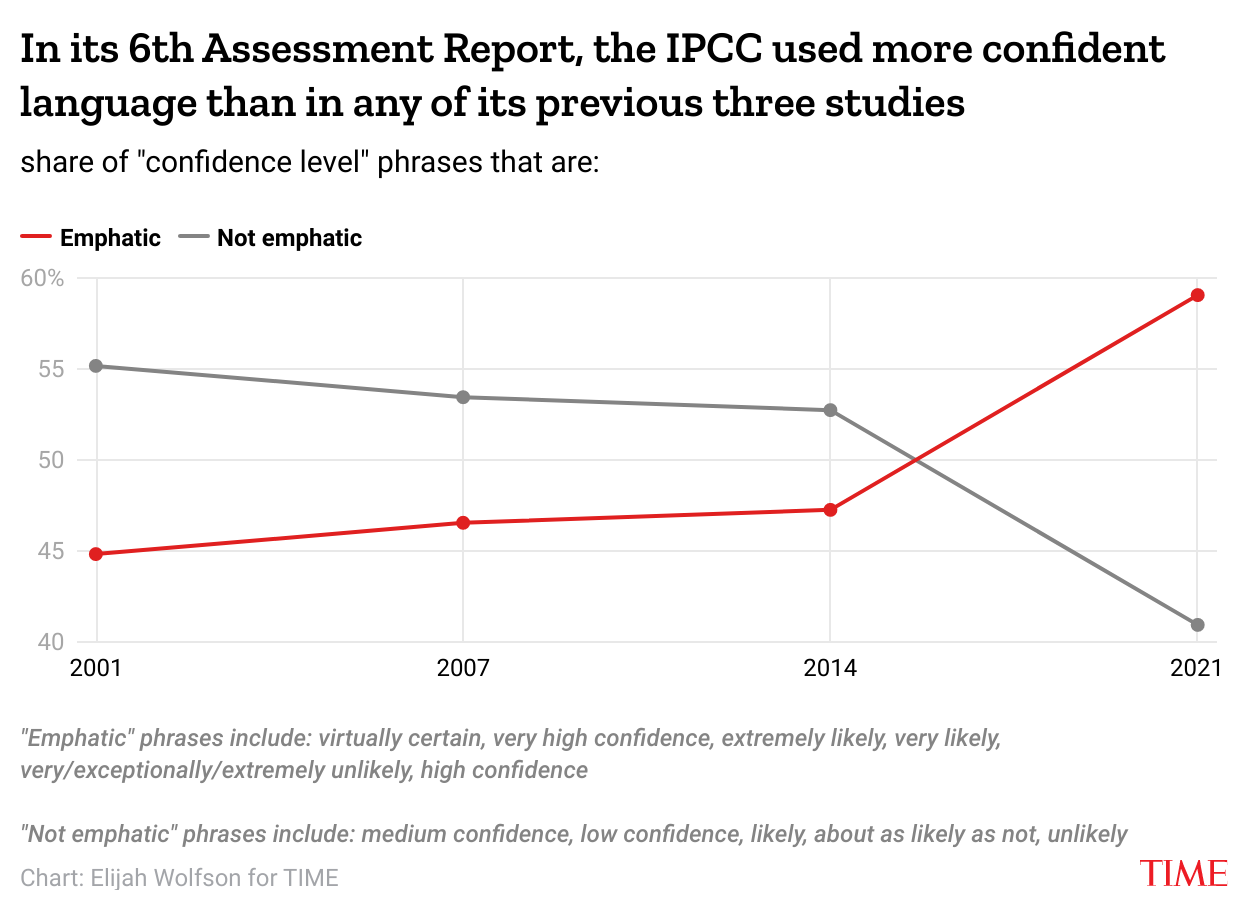
The world is undoubtedly more aware. What is required is a real change of how those in the most prosperous part of the world live, especially when our behaviour impacts those in the least prosperous places even more severely. Scientific consensus will be necessary to ward off the very real campaigns of those who have the most to lose - the fossil fuel industries. It’s good to see the confidence of the scientists gaining ground.
Sometimes studies help

How often do we read of reports and studies and know that all the time put in is probably wasted. They sit on a shelf for a while and then are forgotten as personnel change or recommendations seem impossible because of the cost. I was involved with one such study some years ago in which the cost estimate was $40,000. Ouch, we said - and asked how long could we delay implementing the study recommendation. The answer came back as two to three years. We did nothing. I later left the volunteer post. Recently I hears there was water damage for an estimated starting cost of $13,000 with another $30,000 or $40,000 to follow. Some years ago we had the money in the bank to proceed. Now after shutdown and other events, we no longer have it.
I was glad, therefore, to read about a study that seems to have some practical implications for something I know nothing about - except for eating salmon. I am joined by the people of the Wiulinkinuxv First Nation on Rivers Inlet BC and some grizzly bears who depend upon it for survival. The latter animals are magnificent and I saw some at close range when travelling in the Yukon fourteen years ago. One actually stood up suddenly on hind legs, but we missed the photo op.
In this case, the study looks at how a resource under pressure can be managed to benefit an entire system. Both the community and the bears depend on salmon for food. Over- fishing can deplete the stocks. Twenty five years ago commercial fishing did just that.
What was used was a new approach called ecosystem-based management. It quantifies the relationship of how much use can be made of a food resource for humans and bears without jeopardizing the salmon population in the future. At one point the location had plenteous resources of fish, but overdoing commercial fishing depleted the stock and put the people who lived there in danger from starving bears coming too close. Commercial fishing was halted.
The researcher started working with the community to gather hairs from barbed wire fences that the bears left behind. Isotopes from those hairs allowed the researcher to determine what percentage of salmon was part of the bears’ diet. Over time that percentage created a formula published this week in the Journal, Marine and Coastal Fisheries - (not my normal weekend reading, of course. I learned about it from The Globe and Mail). The researcher, Dr. Megan Adams, spent seven years to see if the bears were gradually able to consume more fish. What it showed was that if the local population reduced fishing by 10% the bears could gain the same amount and be healthy. Since commercial fishing stopped, the stocks have returned - but not at a level to resume commercial fishing.
There are lots of studies that probably please other academics, but have little functional application to make life better for both humans and grizzly bears. Bravo for this one.
What Freedom Means

We don’t have a line in our national anthem such as “the land of the free and the home of the brave” as our neighbors to the south have. But it is certainly causing more problems in America than in Canada over the right to be free from vaccinations. After a slow start, Canadians are now ahead with nearly 60% fully vaccinated and 71% with one dose according to Covid-19 Tracker Canada. 26,601 have died since the beginning of the pandemic as opposed to 613,000 in the US. Ours is roughly a tenth of the US population.
Yes, we have unvaccinated people - some who oppose for supposedly religious reasons, some with difficulty of access. But generally people have been supportive and appreciative of the opportunity to contribute to their own health and that of others. When restrictions are lifted quickly, some are quick to object to the speed of it.
Contrast that with Florida where 10,000 are currently in the hospital. Its governor insists that “the left are coming for your freedom” if anyone thinks that regulations should be tighter. Freedom is about personal choice.
Sometimes of course we are highly selective about personal choice. The Canadian government more than a hundred years ago thought that it could convert its first nations population to its own cultural values and exerted its privilege. It’s taken us a long time to realize that was wrong. We can argue about the size of government, but in some circumstances we recognize a responsibility to introduce policies that protect the majority of people. As Paul Krugman observes in a column in the New York Times this morning:
“Well, driving drunk is also a personal choice. But almost everyone understands that it’s a personal choice that endangers others; 97 percent of the public considers driving while impaired by alcohol a serious problem. Why don’t we have the same kind of unanimity on refusing to get vaccinated, a choice that helps perpetuate the pandemic and puts others at risk?”
It appears that carrots - like $100 for laggards - are not working - and the previous compliant ones don’t see why their tax dollars should support such practice. What does seem to have an effect are sticks like consequences. You can be as unvaccinated as you want, but expect that to affect your ability to come to work, to enter a theatre, bar or arena, or avoid being tested a couple of times a week with an unpleasant procedure. It’s not only freedom lovers who get to make the rules.
Krugman goes on to say that “freedom” often just means “privilege” for people who are also white, male and sometimes Christian. Freedom can never be divorced from responsibility or consequence.
Pro and Con

We live in interesting times. Who knew that ethical issues are now mainstream? Should vaccinations be mandatory when one side insists on individual freedom while another thinks that responsibility for public health concerns come first? Should news media give equal space to two sides of any argument whether they contain true or false information? If more people get their news from social media, should it be monitored by the platforms that own it?
But another interesting one concerns lobbying. The government of the Canadian province of Alberta has recently spent $3.5 million to explore perceived lobbying by others to work against extracting oil from its oil sands - which used to be called tar sands before that sounded like an unpleasant black thick substance. Among those caught in the net is respected environmentalist Bill McKibben. He is apparently mentioned several times in the soon to be published report and is given a chance to respond. He does so in a New Yorker article titled, No, Alberta, Don’t Be Sad. We Love You. Really.
He wants to make it clear that he is not against Alberta itself - which the study seems to insinuate. What he is concerned about is the burning of the large amount of fossil fuel that the province still has in the ground - about 173 billion barrels, he says. That would create 112 billion tons of carbon dioxide in the atmosphere - 28% of the world’s remaining carbon budget set by the Paris accord. We live in a country with less than 1% of the world’s population and McKibben stresses the unfairness of that use by a single province of it. The world has gradually become aware of the situation and the potential damage.
McKibben is quick to point out that he has been part of the process of questioning the ethics of this use, but that Alberta has not been the only place on the radar of 350.org the company he founded. Its name was named after 350 parts per million — the safe concentration of carbon dioxide in the atmosphere. In June 2021 were already at 418.94 parts per million, up from 416.60 in June 2020. Since 2009, 350.0rg has advocated for a reduction of fossil fuel use all over the world - not just for Alberta.
And Alberta itself is starting to see the perils of climate change within its own borders. It’s normal to feel resentment when it has taken us so long to see the impact and understand the cause. but what if that same $3.5 million had been allocated to new possibilities rather than trying to live in the past?