My writings - and those of others.

The Ecological Age
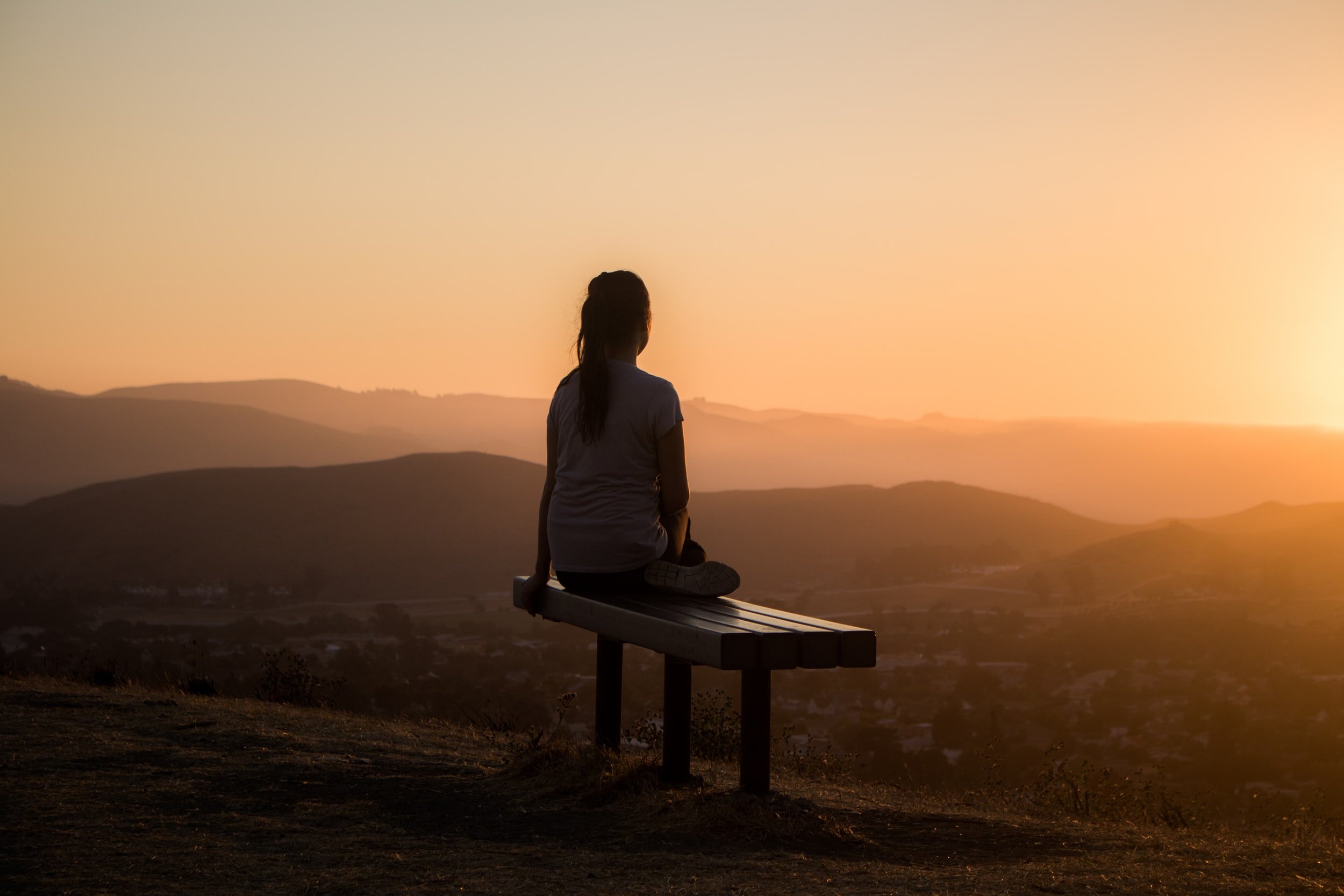
This quotation from Thomas Berry’s The Dream of the Earth is of the utmost importance:
“Presently we are entering another historical period. one that might be designated as the ecological age. I use the term ecological in its primary meaning as the relationship of an organism to its environment, but also as an indication of the interdependence of all the living and nonliving systems of Earth. This vision of a planet integral with itself throughout its spatial extent and its evolutionary sequence is of primary importance if we are to have the psychic importance to undergo the psychic and social transformations that are being demanded of us. These transformations require the assistance of the entire planet, not merely the forces available to the human. It is not simply adaptation to a reduced supply of fuels or to some modification of our systems of social or economic controls. Nor is it some slight change in our education system. What is happening is something of a far greater magnitude. It is a radical change in our mode of consciousness. Our challenge is to create a new language, even a new sense of what it is to be human. It is to transcend. not only national limitations, but even our species isolation, to enter into the larger community of living species. This brings about a completely new sense of reality and value.
Soil and its importance

A few years ago our balcony railing structures were replaced. This meant that balcony contents had to be removed, including planters that I had brought full of soil from a previous residence. Several bags of soil went into the garbage. because the containers had to be empty to carry to a storage locker. This year, when I tried to replace potting soil, I had to go to several places before I could find the right size bags to carry. Home gardens have become increasingly important as we move beyond the pandemic.
We hear a lot about air pollution and water pollution. I didn’t think seriously about soil pollution and soil loss until I read a couple of recent articles. Organic gardening is a term we have heard about - but regenerative agriculture is less familiar.
As someone who grew up in Western Ontario, my family took Sunday drives into some of the most beautiful family farm lands in Canada. As a pre-teen I even got to visit and work on a farm and drive a tractor in a field. We’re all too aware of industrial farming and the dangers of pesticides - but agriculture as a source of CO2 isn’t something we reckon with. Some are starting to do so, by recognizing that agriculture contributes 25%. The Intergovernmental Panel on Climate Change says: “Leveraging the mitigation potential in the Agriculture, Forestry and Other Land Use sector is extremely important in meeting emission reduction targets.”
Rodale Institute says. We have proven that organic agriculture and, specifically, regenerative organic agriculture can sequester carbon from the atmosphere and reverse climate change.
There are several ways this can happen:
Decrease or eliminate plowing and tilling. These compact the soil and release too much CO2
Plant diverse crops, as opposed to huge single crop plantings
Rotate and cover crops. Protect and cover crops rather than letting them leech nutrients.
Kiss the Ground, a restorative agriculture not-for profit says: “If regenerative means: ‘renewal, restoration, and growth of cells, organisms, and ecosystems,’ or ‘renewal or restoration of a body, bodily part, or biological system (as in a forest) after injury or as a normal process,’ then regenerative agriculture is agriculture that is doing just that.”
We are not here to exploit the soil. We are here to learn that health of the soil is essential to our own health - and the health of the planet.
Importance

i’ve been re-reading Thomas Berry in the light of some current events in Canada - the reminder of the deaths in residential schools - well known and documented in the Truth and Reconciliation Commission Report - but not absorbed, so that recent findings are treated as news. Then there is the recent senseless killing of a family because of ethnic hatred of a disturbed young man. Last is an article by a Roman Catholic rightly decrying the theology of his church claiming that as an institution it can do no wrong - only individuals within it can.
Berry speaks of the moral dilemmas of our age which so-called civilized peoples and religions cannot deal with - suicide, homicide and genocide. He adds to them terms that we never hear from any of the religions by name - biocide and geocide. As creatures of the Anthropocene, we think we can do what we like. We fail to see the consequences.
Questions and answers

Here are the definitive questions and answers to the questions on climate change. It’s worth checking out the ones at the top and then go to the individual responses below. You may know some of the answers already but others may be new. Have a look.
The answers are extensive and also have links to further articles. It would ne good to set some time over the next few weeks to tackle one of the questions and responses at a time. An educated public is necessary. Misinformation is usually tied to an agenda. Sober realism is the necessary antidote.
How to See
I’ve spent two hours a week this year taking an online course in abstract watercolour painting. The course and others are offered by Avenue Road Arts School, which used to be an actual place and has gone digital for a while. That means that people can join in from any where, rather than just in Toronto as I used to do. The instructor, Sadko Hadzihasanovic, has established an international reputation, but still enjoys working with amateurs and sharing his insights with energy and new technological skills to help us over Zoom. We can email our works in progress and he often make suggestions of small changes in the images on his ipad and sends them back. Often it’s composition where we need help from an experienced eye.
Sometimes abstracting helps us reconnect with the real world. Taking an idea to the next step and putting it into a visual framework we know can send a message that moves us to new understanding. “Poets are the unacknowledged legistrators”, the poet Shelley said. So are any artists who help us to return to learning through our five senses.
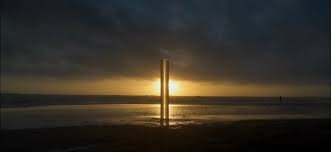
San Francisco Artist Ana Teresa Fernandez recently sat down with Bill McKibben to speak about her social sculptor, On the Horizon. It was a response to a comment she heard that sea level will rise six feet in the next fifty years. That’s a nice abstract number, but what does it look like? Her answer as a creator was to put a six foot tube on the beach, fill it to the top with the help of children who will face that reality and let viewers of all ages respond to it.
You can see it here:
What does it look like? How will it change us? Why is this happening? Artists ask the questions that in our day to day pre-occupations we avoid. We need them th help us see what we are doing to ourselves.