
My writings - and those of others.

Armchair Quarterbacking

The morning news pundits and reporters raise several issues that they are complaining about today, leading me to wonder how they would actually manage them better. I doubt that I could and suspect that they wouldn’t do any better. But I can sometimes reframe the questions. What are the ones they raise for me?
Is the CEO of one of the country’s large bank the person in the best position to tell the government not to give too much money to the poor and needy? Does he know what having no income at all feels like?
Does rioting in Northern Ireland solve its problems relating to Brexit?
Who should be vaccinated first?
Since distribution policies are causing vaccine surpluses in some communities, while others who need them have no access, are there better ways to fulfil distribution?
Is anyone looking at ordinary Americans need guns at all, rather than chipping away at ways to reduce their use?
Why are provinces in Canada denying sick pay and sending people to the federal government - when the federal government program doesn’t cover the income lost through sickness, doesn’t allow application until after the pay is lost, and has a difficult enrollment process to obtain it?
Why, when parts of the world despair of having enough vaccines, does a Canadian company that wants to produce them, have such a difficult time to get government support to do so?
Why did a prime minister let his family support a charity so obviously involved with celebrity star power?
Why were big box stores allowed to sell anything but essential items in the first place during the entire pandemic?
If we want to reduce carbon emissions from cars, why aren’t we looking at how other countries have produced such cars at lower cost?
Why haven’t public health communications looked more closely at human behaviour patterns?
Why do corporations get away with paying low taxes or no taxes?
I haven’t easy answers to any of these. And therein lies a tale. Most of us spend little or no time on thinking about any of these. That means that we let others muddle through when the possibility of better answers depends on the engagement and determination of all of us to create better answers. These are opportunities missed.
Ponderings

An Easter weekend rather like no other. A minor knee injury made staying in less of a punishment than the current pandemic. And other experiences gave it some positive flavour that probably would not have happened otherwise.
I finished Elizabeth Wilkerson’s admirable book Caste. As a PBS Newshour watcher I feel in good company when I see it on the bookshelves of both Jonathan Capehart and David Brooks. Its strengths relate to its impeccable research and portrayals of three examples of caste systems - India, Nazi Germany, and the United States - with their long term effects on their cultures and how they handle them. Her personal experience in India and America also brings the experience of caste to light. This is a must read for anyone who wants to see a different outcome to our heritage of race and caste and gives a reality to any settler culture like our Canadian one.
The next was a presentation that happens once a month, led by a Roman Catholic leader called an eco-sabbath. In past times it would not be possible for me to attend these because of a time conflict, but in Zoom time, that changes. Dennis O’Hara noted that he had tried this presentation ten years ago and met considerable pushback - but decided to try it again on Easter Day. His main point was that resurrection applies not only to the Christian story but the story of the universe itself. These views come from his understanding presented in the writings of American “geologian” Thomas Berry and Australian theologian Denis Edwards. In both writers, the universe itself moves toward fullness and fulfillment. The resurrection for today happens through our meeting all the creatures and creations of the world with the opportunity to ease their suffering and help them realize their full reality and beauty.
His audience was far more accepting of this view this time - formed by the writings of Berry whose influence on the book and film presentation “Journey of the Universe” is also celebrating its tenth anniversary this year.
The last was a good column yesterday celebrating the views of indigenous leaders in The Globe and Mail. Known as Jaqueline Ottman where she is Vice Provost of Indigenous Engagement and Professor at the University of Saskatchwan. But she is also known as Misiwaykommigk Paypomwayotung in her Anishinabe first nations community. She is an advocate for indigenous ways of knowing and being.
Spending a lot of time with a grandmother who understood medicinal plants and astronomy, and who had escaped being sent to residential schools and retained her original language, was a rare advantage. Ottman learned both the language and her culture first hand. She had the rare privilege of seeing western culture through those eyes as she was able to continue her secondary school and further education. And this combination as well as encountering racism framed her search for social justice.
She notes that the closest ideas of western leadership to those of her own community would be servant or adaptive leadership, adding to this both respect for the views of the ancestors and a recognition that decisions look ahead to the next seven generations. Our North American culture contrasts strongly as we neglect our history and express concern for our grandchildren - only two generations ahead. It also has huge implications for how we treat the land - not as part of all our relations, but as something to exploit.
A good Easter - transformative and thought provoking. What actions can evolve?
Minimalism

Technology simplifies our lives but it also affects us in ways we don’t realize until we are without it. I recently fell and wrecked a knee; that meant I prevailed upon a son to drive me to a routine eye appointment. I could take a few steps with a cane or hiking poles but going any distance was still pretty panful.
He called ten minutes before arriving to ensure I was at the door. In fact we were early and drove around so as not to arrive too early - showing how we use the automobile without thinking as to how we are affecting the planet by doing so - but that’s another story. I got to the office, went through the inevitable Covid screening and as usual sat for a wait. A woman sitting across from me - properly distanced - was gazing at her phone and I automatically reached for mine. It wasn’t in my purse.
My first reaction was to panic - and then to beat myself up. It was already in the purse when my son called. How could I have stupidly laid it aside? To make things worse I was to text him back when I was ready for a ride home. What was his cell number? I could remember the land line, but had they cancelled it when all four members of that household had Iphones? I couldn’t recall his cell - or that of any other family member.
I had lots of time to think through a way to connect. I was pretty sure I remembered another son’s cell - but now my stupidity would be revealed even more widely. But son number one has a business website. Wait a minute, I thought - he probably has a phone number on that site. When I finally saw the optometrist and sheepishly told her my problem, I asked whether she could check his site. She did and asked the receptionist to call my son letting him know I would be ready for a pick up in five minutes. Problem solved. The receptionist handed me a little slip with his number on it - as well as giving me a card with my next appointment. It’s still in the purse and reminds me to jot it down in my Bullet Journal. I just did. I’ll also try to memorize his cell number.
I’ve been recently reading Cal Newport’s Digital Minimalism - actually listening to it as an audiobook on the Libby app on my tablet. Is this Minimialist? I’m not addicted to social media but my aging brain has conveniently downloaded some important information to a small portable computer. I didn’t need my own - but it was interesting how reliant I was on those of others.
As it happened, my own phone had dropped out of the small purse and my son noticed it on his car seat. He did have confidence that I would figure something out - so that’s at least something. And instead of going home we went to his house where a bunch of Celtic musicians were playing in the back yard - and I got to join in by playing on a 77 key battery powered Roland keyboard. I still agree with Newport that we are overly reliant on our technologies. The important thing is good choice of where and when.
Another Woman of Note

Katherine Hayhoe turns up frequently when climate science is the topic. She came from Toronto and studied first at the University of Toronto starting with astrophyics but later became interested in climate science. Until recently she was head of climate science at Texas Tech University but has stepped down to become the first head of the Nature Conservancy - the first woman to head that body which is involved in environmental protection in 72 countries.
Hayhoe has a particular gift as an Evangelical in speaking to relgious organizations from that perspective. In a seminar when she appeared in Toronto, she noted that if she could convince her preacher husband, after that anyone else would be easy. Along with other women scientists she has teamed up to start Science Moms, providing basic information for families of young children. As well as its website, it has embarked on a number of public service bulletins to spread the word.
Hayhoe has received several citations for her work on climate: the U.N. Champions of the Earth award in 2019, and climate ambassador by the World Evangelical Alliance. You can also watch her TED talk here and add to the four million views.
Democracy and Climate
When we make The UK Guardian with news that one of Canada’s political parties refuses to state that climate change is real, we might like to shrink with embarrassment. When the Supreme Count rules that the federal government does have oversight of climate change - part of the continuing conversation about whether provinces or national government takes the lead, we might feel better - even if the decision is not unanimous. Decisions need clarity in a democracy.
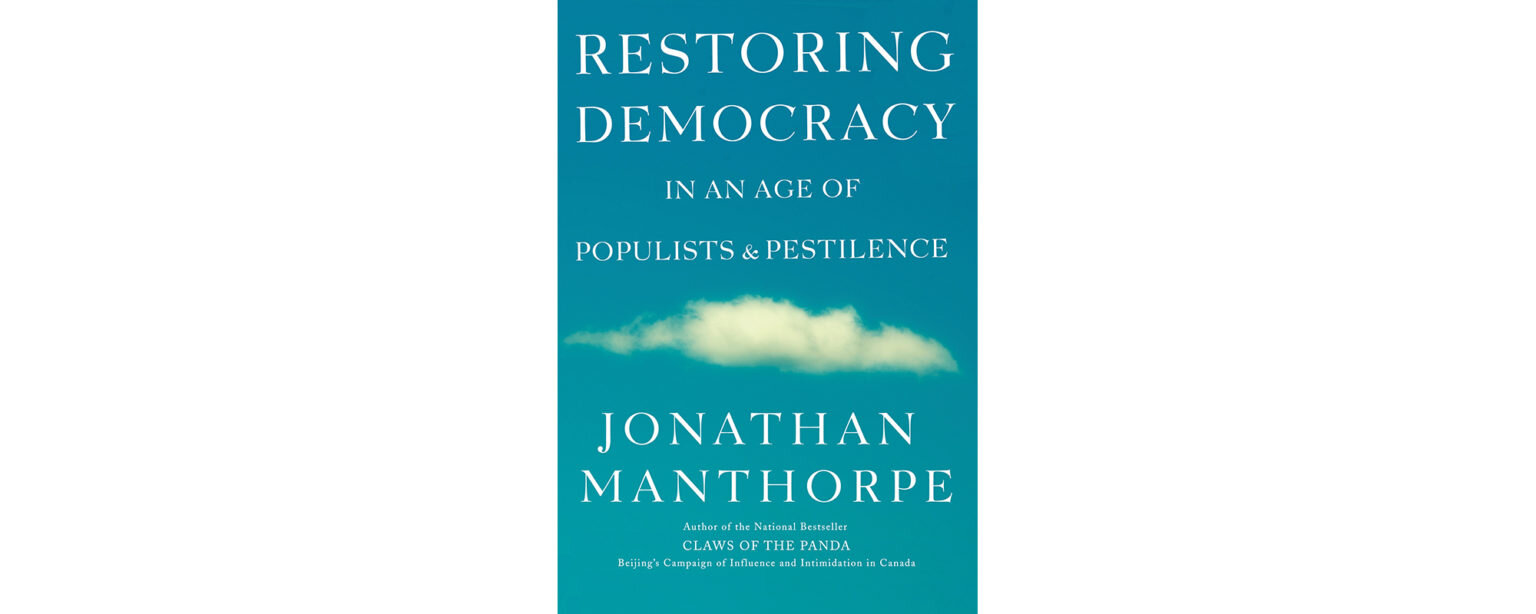
The second book I read recently was Jonathan Manthorpe’s Restoring Democracy in an Age of Populists and Pestilence. It reflects his more than 40 years of work as a journalist and is an excellent review of what has happened in a wide range of countries. He notes that Francis Fukuyama’s original optimistic view that the only things that could affect western liberal democracy would be religion and nationalism and that wouldn’t happen - except that it has. By now, both know that and Manthorpe worries about its impact on his grandchildren and their world to come. Authoritarianism is much more popular and dangerous now in the West and Brexit and Trumpism bear that out. Before dealing with them in some detail he reconstructs the last two decades in the former Russian empire and the rise of China in a face paced and entertaining read.
He’s less worried about Canada than Europe or the United States but he doesn’t let us off the hook entirely. Compared to other countries we may look calm. While the first half of the last century was influenced by our British heritage - and my own life reflects that - the last half drew us closer to America. Now we feel somewhat estranged from both. The Huawei involvement has created new problems with China. Our isolation from traditional partners may require us to seek new ones. Manthorpe is not happy about our political administrative government systems imported from Britain, especially because of the differences in our geography, where huge areas create regions with different stresses and aspirations. Federal and Provincial conflicts are a way of life - but more interesting to the politicians than ordinary citizens. Getting things settled by the courts doesn’t necessarily help.
Our media, like those of our neighbour to the south, focus on news as entertainment and opinion often swamps actual news reporting more often than we realize. The lack of local press makes this even worse. Regional grievances are rampant. We have too many governing bodies with endless subcommittees that operate as silos; only a crisis like a pandemic lays these bare. Politics has taken a focus on leaders as folk heroes or villains making politics a matter of celebrities and influencers, rather than a matter of policies. Partisanship is not as virulent in Canada as it is in the US, but it is there - and a central consensus is becoming harder to find. Our reliance on oil and gas is going to be a force to be reckoned with. We require restructuring and retraining even more since the emergency of the pandemic.
Votes and voting will matter. So will a civil service that is competent and respected by all political parties. As we move into the new pressures brought on by climate change, engagement and trust of ordinary citizens will matter even more.