

My writings - and those of others.

Egged On
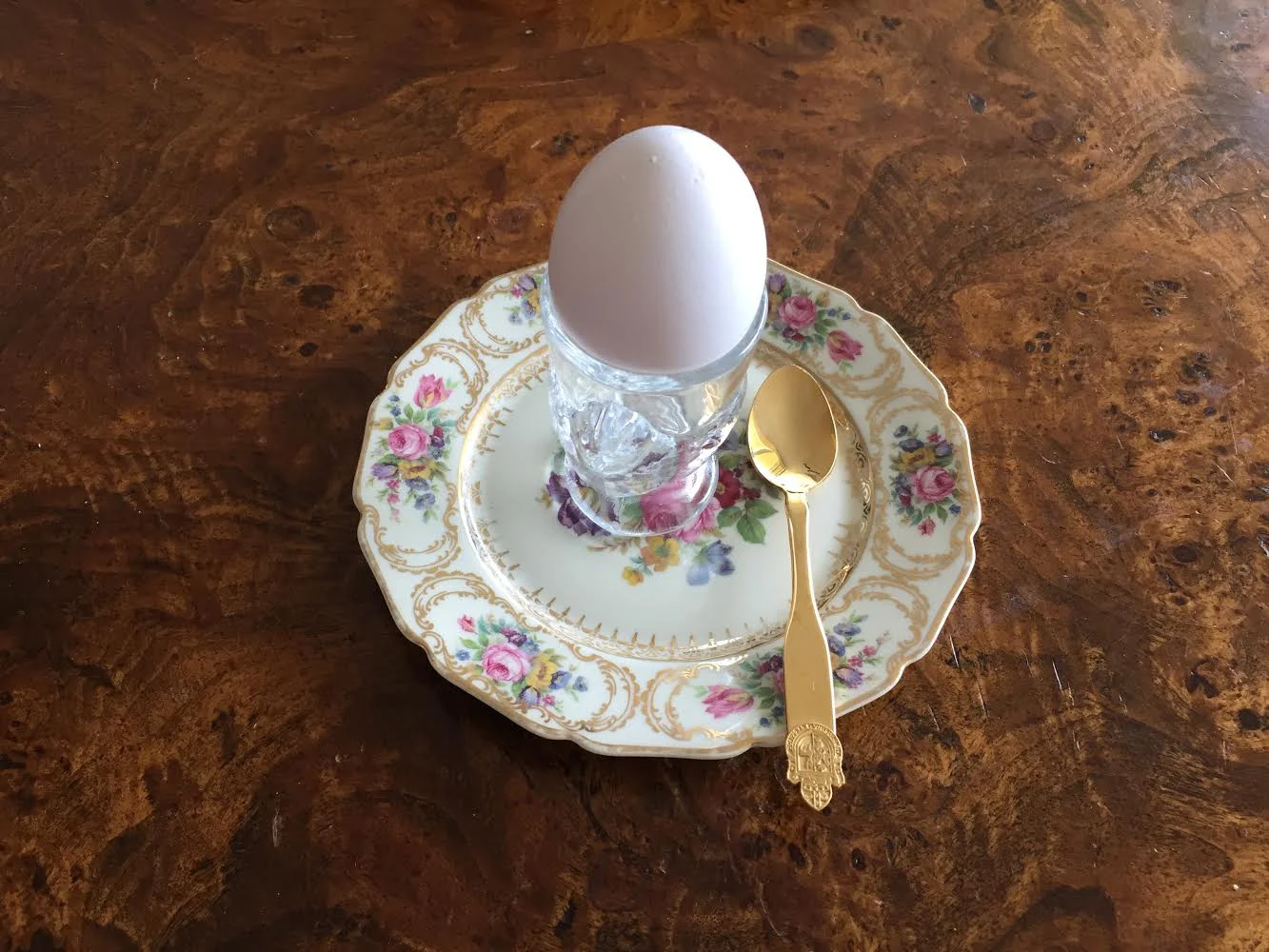
The author Ursula LaGuin died in 2018 at age 88 after a long career as a distinguished novelist, poet and essayist. I picked up a book of her essays, No Time to Spare, Thinking About What Matters and very much enjoyed the opening one, “In Your Spare Time”. She reflected on the survey she had received from Harvard asking about how she used her own spare time, with a checklist of 27 items. The first was “golf” and she didn’t put a check mark there. I wouldn’t either. But as she went on to say, this is a strange question to ask people in their eighties. I agree. All our time is spare time.
LeGuin observes that normally we think of spare time as free time left over from a job or working hours. There were other things to check on the Harvard list that she didn’t tick off and I wouldn’t either. Racquet sports? – No. Bridge? – definitely, No. When my husband was alive he always chose to play against me. When he won he was happy and when he lost he was amazed. Shopping? – “if necessary would have been better than -Yes. TV? – we would be lying if we said No – and last but not least, “Creative Activities” – specified further as Paint. Write, Photograph etc.
Like LeGuin, I don’t regard “Write” as a spare time activity. I’ve written all my life as I am doing right now. Most of my writing would be regarded as non-fiction whether paid or otherwise. It includes reports, newsletters, articles, grant proposals, a book. journals, letters, minutes, agendas, websites, blogging (since 1995) and more recently posts and tweets – plus a few poems. Writing is a continuum. It’s not about spare time. It also suggests the Harvard survey writer didn’t have a clue what it might be like to live for eight decades. I find myself thinking that way about a lot of other people too.
It came up when I read about my university’s alumni celebration dinner – to be honest I wasn’t reading at all but watching a video - containing a frame picturing a large collection of golden spoons. Those who graduated fifty years ago were to be recipients, as I was nine years ago. “That’s lovely”, I thought – “but has anybody asked whether that’s what we really need from the university after fifty years?” Were any alternatives considered? A massage certificate? A discount for upgraded reading glasses or hearing-aid batteries? Boots with better treads?
But LeGuin, bless her, has come up with the proper use for the golden spoon. Maybe between our fixation on probiotic yogurt and fibre-filled cereals, we have forgotten about the frequent menu item of our childhoods – the soft boiled egg. In her chapter, “Without Egg”, she even gives instructions on how to cook one for the benefit of recent feminist grads who wouldn’t be caught dead in the kitchen. And to go with it, she spends a bit of time on the egg cup. Apparently American homes no longer have them – and I am tempted to put a picture of one on Facebook in the “Share if you know what this is” category. Of course I still have one – three in fact. I also still have the Corning ware with the blue flowers on it which was a popular shower present for weddings in 1959.
After some discussion as to whether the egg should be placed in the cup with the larger or smaller side up, LeGuin moves on to the search for the proper spoon. Before that, she notes that a knife must be made of steel and the spoon must be untarnishable. “I’ve never seen a gold egg spoon but I’m sure one would do” she says. VOILA! I rushed to buffet drawer filled with odd bits of silver and there sat the spoon unopened in its little plastic gift box. Now it becomes a neessity and like Leguin, I start the day with a boiled egg and an English muffin – and browse another of her essays. My favourite to date is entitled, “Would You Please F*cking Stop! You’ll have to read it yourself to find out what it’s about.
Meetings Revisited

Recently a friend observed, "Sometimes all we do in a meeting planned to produce useful output is just talk". It reminded me of an article I wrote a long time ago on the subject with some specific pointers. They still sound useful after fifteen years.
Why Hold One at All?
Start with a planning mind map or list. The first branch to place on your map is the reason for holding the meeting in the first place. Imagine the meeting as a finished entity. What happened? What results were accomplished? What are the next steps? If you don’t find immediate answers to these questions, consider why you are holding the meeting at all. There may be better ways to deal with the issue at hand. Perhaps you need to speak to one person, not an entire group. Perhaps the meeting could be better accomplished by a telephone conference call or an online conference, particularly if the participants live in different cities. If your main purpose is to convey information, it might be better to simply send a memo. If you are making an important announcement, why not throw a party? Before you call the meeting, decide the appropriateness of holding it at all.
Set the Stage
If you are going to proceed, compare a meeting to a theatrical presentation. There is action in three parts of the theater, -- backstage, main stage and in the lobby following the show. The backstage effort, -- the gathering of the props, the rehearsal of the scene, the preparation of the program are going to determine the overall success of the performance. Start your visual map with a branch that includes the participants. Follow by mapping the agenda items. Put them down as fast as they come to you in random order and get them all down on the page. Look at which items are simple and straightforward, which are controversial, and which involve the whole group. Look at who should report on the various issues and who might present the topics.
Now it is time to order this raw material and put it into a clearer order and time frame. Decide on the duration of the meeting. Confirm who needs to attend. Decide on the order of the items on the agenda. It is well to warm up on non-controversial items and place the most contentious issue in the middle. It is also a good idea to follow the controversial issue with a neutral one, or deliberately delay decisions on the items following the controversial issues, so that opponents won’t use the remainder of the meeting to seek revenge for past action and kill each other off.
Decide on the resources that you will need for the meeting. Do you need a projector or flip chart? Do you need background papers or other references? Insofar as possible, send the agenda and its attached documents to the participants well in advance of the date. Encourage participants to read all reference materials in advance. Otherwise you are going to convene a meeting of readers, whose faces will never rise during the meeting because they are buried in reference documents. How can there possibly be any useful contribution on any issue if the meeting is the first time people know anything about it?
Now it is time to move to center stage. Choose your meeting room carefully. If possible, get a room with good natural light. Pay attention to ventilation and temperature because these are vital to the energy of the people attending the meeting. It is important to bar interruptions. Deactivate the phone in the room and ensure cell phones are in a bucket in the centre of the table.. Place a “Do Not Disturb” sign on the door.
Provide the proper materials. Make sure that any additional printouts and reference materials are available for each participant. Have a flip chart with markers of the appropriate size at the ready. If you really want to stimulate the participants, provide them with bright markers and highlighters. If money is no object, equip the room with an electronic white board.
On With the Show
“I’ve been on a calendar, but never on time. ”
Start the meeting promptly. Don’t penalize those who arrived on time by waiting for the latecomers. Don’t interrupt the proceedings to acknowledge the latecomers and bring them up to date. You’re simply reinforcing their tardy behaviour and making it acceptable.
If you are the chairman, it is your responsibility to control the process. Your meeting agenda is a constant reminder of the material that you have to cover. You will need to worry less about the talkative participant who will have always plenty to say when you have the big picture in front of you. If you are smart, you may have already asked the most garrulous or the most bothersome member of the group to take notes. Balance participation by inviting the quieter ones to comment. Often their contributions will be more worthwhile than those of the chatty types. Summarize the proceedings as you go. Emphasize the positive and show appreciation for all contributions.
Map the Minutes
Use the briefest possible format outlining results - avoid summarizing the discussion unless points made will be useful at a later date. What is to be done? Who will do it? When will it be done? Don’t provide any more content than necessary. You want participants to spend their time on the necessary follow-up, not on reading.
Be Your Own Best Critic
Evaluate each meeting. What went right? What went wrong? Who participated? Who was silent throughout? What feedback did you receive? Be prepared to spend time following up with participants who have concerns arising from the meeting. Be prepared to hear from those who said little during the meeting because something was probably upsetting them.
Last, but not least, keep good records. Visual maps provide excellent recall of what happened and can be reviewed quickly. If you have a number of memos and minutes for an organization, a committee or a department, consider keeping the documents in a three ring binder rather than in flat files. That way it will be easier to retrieve the documents you need.
The Show Must Go On
The last meeting’s minutes always provide the starting point for the next. Start the cycle by reviewing your previous map agenda and minutes and see where you stand on the issues which were addressed. Some matters may have been delayed and need to get back on the agenda. Some need review. Some persons need to be commended for their achievements. Others need to be reminded of reports that should be made. Using this process as your planning tool will really get your show on the road.
A Good Long Weekend

Canadians still celebrate a long weekend in which the Monday is called Victoria Day. I always remember that my father lived under six monarchs. A Royal Wedding then is a good way to start a Saturday morning. Unlike a younger generation family member, who said "Enough Already", I joined the millions at 5:30 am since I was already awake. As someone who read "The Little Princesses" by the Queen's Nanny, I was already primed at about age seven for this kind of thing. I've been to all the Royal Weddings - even the one danced by Fred Astaire.
Watching the fashionable ladies arrive was wonderful as a contrast to the knee-hole jeans I sit across from on the subway. Canadians are also bi-cultural so we are able to get both the C of E. traditional and the Gospel part of the ceremony. I've enjoyed reading the reviews of the wedding trom the worshipful to the snarky and amusing. I liked the actor partner from Suits, who when he heard the news of the engagement observed, "And I thought she was just going out to buy milk". It was also fun to see those toothless Canadian pages.
What nobody has commented so far that I have seen though, is this. The Bride's accent is totally American. Those vows were said in a straightforward way that shows no sign of British social class. When I lived in London and beyond in the 1970s, we were a puzzle to our British compatriots because they didn't know where to peg us on the basis of our accents. It was a real advantage because we were accepted and entertained both by the ladies of the big houses and by the women who "did" for them - once that even happened with a high tea and a later light supper on the same day. The last time I was in the UK is nearly 20 years ago and I hope it is better now. But the bi-cultural atmosphere of the wedding with both British and media and sport royalties was quite wonderful - not to mention the charity staffs.
The next day, I saw the musical, Come From Away - a truly Canadian story with Newfoundland accents - plus swearing - true to the core whether learned or inherited. It's good to see that production accepted in other parts of the world. And last evening there were many views of fireworks from a 22nd floor on a clear night. Life is good.
Journeys

Concurrently with reading Life Abundant, I am reading another book responding to a film called Journey of the Universe. Here's an introduction to it. It is part of a necessary step to re-frame the human journey as part of a new story. More on this to come.
Concurrently with reading Life Abundant, I am reading another book responding to a film called Journey of the Universe. Here's an introduction to it. It is part of a necessary step to re-frame the human journey as part of a new story. More on this to come.
It is Like That . . .

“Be careful how you interpret the world. It is like that.”
My laptop is back. I had noticed it was behaving strangely and taking forever to boot up in the morning, but last week it failed. I headed off for GeekSquad which had sold me the unit two years ago. Because I maintain a couple of websites, I stressed the urgency of a repair and went home to wait. I had saved all my documents on USB sticks and the updates were recent.
If you have any doubts about your addictions, take away your devices for a few days. “Left to my own devices” had a whole new meaning and made me ponder my interpretation of the world and what was currently in it. Here was some of it – readings for a couple of discussion groups, daily piano practice (I’m back doing this after resuming lessons), exercises to remedy a problem with the sciatic nerve, finishing reading a novel, cleaning the apartment, needing to do the laundry, grocery shopping. These might be seen as a reasonable workload for an 82 year old.
But they weren’t. I was obsessed with the absence of the laptop. Where was the more sombre view of what was happening in the US as documented in the New York Times online? What did I owe the accountant for my taxes – since the invoice now came electronically? What were they saying on Washington Week? This might seem obsessively American. I live in Canada. I had access to mail on a tablet and a phone. But I felt as though someone had removed part of my brain and it was in the shop. Where were the 20 or 30 newsletters that came through Unroll,me?
Thus, I was ready for of all things – theology. A book, Life Abundant, was buried on a shelf but I hadn’t looked at it for years. I met the author at a west coast retreat centre some years ago and told her I had just bought her book. “Which one?” she asked, and on hearing the title, she responded, “I’m so glad. I’ve been writing the same book 14 times so far and this is the best version yet”. Amazon tells me that there are later ones, but this one is more than sufficient.
The book’s subtitle is Rethinking Theology and Economy for a Planet in Peril. Sallie McFague taught at Vanderbilt Theology School for more than 30 years and is now based at Vancouver School of Theology where she is still teaching and conducting research. She starts this book by explaining that she has spent many years teaching religious autobiography, but when challenged, realized that she had never written her own. It’s a reminder that we all have one – whether we are part of a denomination, or agnostic or atheist. The last thing we generally have time for thought as to what it is.
During re-reading, I was giving myself brownie points that reflection was the most frequent tag on my blog posts, but theology is more than that. I’m generally optimistic and see life more as a comedy than a tragedy. These days it’s more like a farce with a reality show leader keeping us all glued for the latest episode where we couldn’t make this stuff up. We are amused and appalled. But what does it say about us? I’m so busy being a spectator of this soap opera that I don’t need to reflect on my own life – and the fact that I’ve got to be further along on the downward slope than I want to be.
The laptop is back. The hard drive has been replaced and so has a new version of MS Office with an amazing number of new distractions. I have been surprised at how quickly I am up and running. Press a button on the modem – and we’re back on line. Bring back the mail services. Check. Bookmark all the frequently visited sites. Check. Bring back all the saved files. Check. Anything missing? Personal photos weren’t among the saved files. I’ve just obliterated a major part of two decades. Still I later found many of them on a stick. But the lack of care about what really matters has hit home.
So what is this theology stuff? McFague says it is “words about God” but refreshingly she reminds us that it is about an interpretation of the world as we see it. Any theology is going to involve three C’s – context, content and criteria. That’s going to keep us busy for a bit.
Context reminds us that the documents of any faith are written in a particular time in history. These reflect the interpretation of the writers based on their own understanding of the universe in which they dwell. The reflections will be of necessity partial and relative to the context. For this reason. McFague says that any theology needs an adjective in front of it to clarify the group espousing it. The adjective in front of “Christian” for example, might be “liberation, feminist, fundamentalist, progressive – or a name of hundreds of denominations with different emphases and views. The speaker matters.
Content depends on experience – but again McFague notes that experience is the channel and the means that it comes through – not the content itself. Something comes into our life as a revelation or an insight that concerns the relationship of a god or creator that is of such importance that it affects our orientation to the world and our behavior. It’s not religious experience so much as ordinary experience.
The big question then becomes - who is our neighbour. I asked this question in a discussion group in my parish church last week. The answers were what I expected – the person who lived down the block or in the apartment next door – whose name we might not know. But as I look out my window from a high floor, I can observe a barrier around a tree that is going to be removed to accommodate reconstruction of a water reservoir. I live in a large metropolitan North American city. Are my neighbours people of colour? People who live in the third world? People of other faiths? Other creatures? Oceans? A tree?
Our world contains questions that are more than we can ask or imagine. We have to explore further. The criteria will have to wait for a later post.