

My writings - and those of others.


Other changes
I’ve been acting as scribe to a group that started with a move toward a strategic plan and is now changing its perspective to go in the direction of small changes rather than big aspirations. It looks for guidance primarily through its own traditional documents and I join them in that. But I also follow some of the literature that is sometimes termed ‘self-help’, though it may also have implications for a broader community like an organization or a charity. Reading both at the same time may create a sense of disconnect – but sometimes the two converge.
We’re still trying to overcome the challenges of the pandemic – not helped by the news that several friends have just tested positive for the virus, albeit with symptoms rather than full blown illness; but we are not fully safe from it yet. Someone recently observed that he has never been more fearful in the face of government corruption, war, forest fires, collapse of institutions and respect for their role in civil society. We know that change throughout history has often come from the margins, but how do we implement worthwhile changes when we have so little power to participate in either the market economy or the governments that are supposed to counter them.
There is always a gap to what we aspire to and the reality we face. We also live in an era of individual and group self-interests. We may have better angels in our natures, but it is interesting to see how quickly these collapse when our individual or group interests come into conflict with those of others. We’re also in the era of wicked problems with multiple strains that overlap – climate crisis versus employment, for instance – or agricultural practice and its effect on climate, capitalist economies that exploit nature, indigenous cultures destroyed because we wanted their land. Sorting these out is huge and beyond our individual capabilities – but we have to start from the edge – with commective groups like SCAN that I recently described. I’ll pay my membership.
The old wineskins don’t work. But starting with ourselves is hard. I recently picked up a copy of the book, Atomic Habits again. There are several suggestions of ways to start helping ourselves to revisit our better angels – without thinking that personal motivation is the way to go.

The author, James Clear, thinks we have it backwards. We go about making personal changes by focusing on the outcome we want by setting goals. New Year’s Resolutions and starting back to school in September are times we typically do this – and usually fail within about a month. If we want to lose weight or obtain straight A’s these are worthwhile priorities, but we don’t get there by wanting them or willing them to happen. The second stage is the system or process we set up to make them happen and ensure that it is followed with precision. If we were machines, we could set a timer to repeat the process automatically but we are not. We are people driven by emotions even though we have reason, as author Jonathan Haigt describes so well. What Clear prescribes as a way to get around this is to focus on identity – good advice to the young who follow influencers. Who do we wish to become? It means setting up really small steps to get there over time. Such small steps apply to individuals but also to communities. And we have to look at both the systems that are outside of our immediate control – but also at the ones that are inside it. The latter is the place to start first.
Third Act
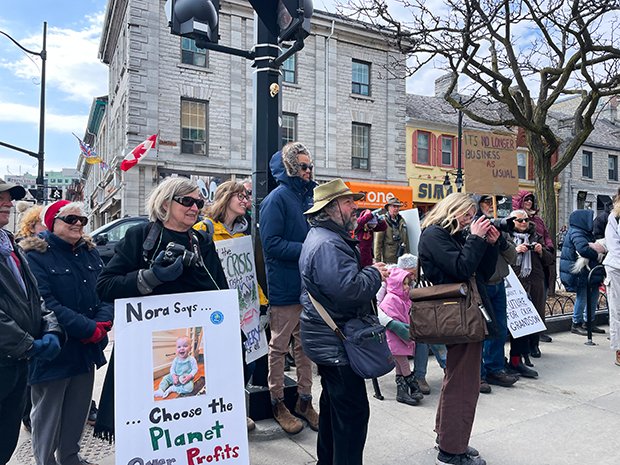
I recently became aware of Bill McKibben’s organization, Third Act in the United States. This icon of the environmental movement encouraged American seniors to act on behalf of future generations. Such people have the time and experience to become good advocates.
Was there a similar organization in Canada? There is - it is Seniors for Action Now (SCAN). https://seniorsforclimateactionnow.org/#.
Here are some of its principles:
· To build an Ontario based action group that is democratic, accountable, equitable and participatory in which we value each others’ knowledge, experience and views.
· To inform and mobilize others to become informed and active.
· To support the young people calling on government for action.
· To engage with indigenous people from whom we can learn.
· To draw on available time and experience of seniors.
They note the need for systemic change:
· Our economic system is built for growth. We have to rebuild it for sustainability
· Our economic system is built for accumulation. We have to rebuild it for sharing.
· Our economic system is built for extraction. We have to rebuild it for stewardship.
· Our economic system is built for exploitation. We have to rebuild it for fairness.
· Our economic system is built for inequality. We have to rebuild it for equality.
The impetus came out of the pandemic which laid bare so many disaparties when we had time to reflect upon them. Regional chapters are already active but there is not one mentioned to date for Toronto – even though some of their activities are aimed at the current provincial government’s climate crimes. The participants are obviously doing their homework and keeping up to date. It is also noteworthy that only two of Toronto’s 103 candidates for mayor have announced a climate policy. The fee for membership is perhaps the only thing to criticize. It is much too low!

Misinformation
Misinformation
I enjoyed the article in this week’s Saturday Globe & Mail in which the author, a journalist, asked GPT-4 to write his biography in 1,500 words which it did in a few seconds. If I didn’t know anything about him I would think it was quite impressive and credible. But he has annotated it, and these are the things it got wrong from the beginning:
Place and date of birth – both wrong.
Beginning of writing career – wrong year.
University from which he graduated – wrong one – there were actually two correct ones replacing the wrong one.
Graduating degree: wrong one.
That was just the first paragraph. The second went better. It was correct in naming him as a journalist, but starting with his first job at a publication that went out of business 11 years before his writing career began. Then we are told he was offered a job at a rival paper – which he was never offered and would never accepted, he says.
Paragraph three states he is the author of 20 books. He wished that were true. The description of his first book actually describes another one written by someone else in 1939. He wishes he had written one on the Canadian wilderness – but never did. He notes that by now the bot is struggling to find 1500 words with fill like “The book was a critical success and helped establish . . . . as a rising star in the world of Canadian literature”. – worthy of the kind of fill any keen grade nine student might produce.
In further paragraphs, GPT-4 expands his output to several books on noted Canadians - substituting books for a review and an article and it got a year wrong again. It went on to describe his teaching career at two universities – he never taught at either of them - and only one year as a lecturer at another one. But it ended with another nice filler platitude. “His courses were popular with his students and many went on to have successful careers as writers.” None of them were named.
Honours - and the lack of them, came next – a Governor General’s medal for writing – but the reality was a nomination for one book and the topic in its description was wrong. Awards supposedly for column writing also do not exist. Alas, he is also waiting for the Order of Canada mentioned in the GPT- Biography. To make it worse, he is reported to have died in 2016 – though he is still here to write the article. With a bit more commendation the bio finally reaches its 1500 words – “as his legacy as one of Canada’s most beloved authors and journalists lives on.” He does say amen to that.
We don’t need to fear GPT-4 for accuracy any time soon. But if I had read the bio without the annotations, I could well have believed at least some of it. That’s the danger. In the meantime, I’ll request my own 1500 word biography and see what happens. I just hope I am still alive.

Thinking About Data
Recently a friend noted that he wanted to talk soon about his use of Chat GPT for better writing and I’ll be interested to see the results = without being tempted to try it out for reasons that follow.. My first encounter with artificial intelligence was through Kevin Kelly’s The Inevitable, Understanding the 12 technological Forces that will Shape our Future, which I read soon after its publication in 2016. AI came in as number two in a chapter called Cognifying – after a chapter called Becoming – dealing with the inevitablity of always having to upgrade our devices.
I’ve just read a bit of the book again. I enjoy telling young persons advising me on the latest technology that I first turned on a desktop in 1983, was on CompuServe by 1989, added the web the next year, and had my own website in 1995 – a one pager with no images. Kelly was a couple of decades ahead of me, but I relate well to his sense of excitement of where we have been – and take seriously his notions of where we might be going. Like Brian Arthur, he notes that technology frames us after we adapt it for our own purposes and it creates the cultural era. I look forward to re-reading the whole book again.
Kelly points out that AI technology was already here as a force when he wrote the book – because of the networks of information already in existence. He said, “It will be hard to tell where its thoughts begin and ours end.” He also pointed out how its utter ubiquity hid it from us even then. AI is the ultimate disrupter and suddenly the ability to deal with quantities of data is in our hands. I can remember when a mainframe was the size of a dining room and now I have instant data available on my phone. As Kelly points out, it was the magic of combining computer/phone/internet that has happened during less than half my lifetime.
When the latest New Yorker came through the door, I tried not to add it to the pile of others immediately and turned to the article by Jill Lepore, their excellent staff writer who tackles many current topics. Lepore received her Ph.D. in American studies from Yale in 1995 and is the David Woods Kemper ’41 Professor of American History at Harvard University. The article’s title is Data Driven and it resonates particularly as I serve as a volunteer secretary for an institution which is reviewing its immediate past and deciding where it wants to go. Online Zooms and surveys have become part the scene and its steering group has been given quantities of data to sort through. I don’t have to read it, but like the other volunteers, I browse through. From workers recovering from the pandemic, there are many responses of “poor me”. There is also dissatisfaction with reduced revenue and attendance, a typical desire for more from the young and a general sense of foreboding. It’s hard to find the desired glimmers of hope – and one solution has been to turn the data over to a bot to sort it out.
Not precisely a bot – it has been turned over to an outside consultant with a bot that attempts to put single words in larger contexts. “Day” is a simple word. “Good day” and “Bad day” mean something different. I was pleased to see the observation that the coding of the data into larger sets was something that she had done totally subjectively. Putting the data through this process was helpful even when the sample of the total population she was drawing from was very small – about 2.4%. But we are encouraged to listen to the data to predict the future. even as we really know we can’t.
Lepore starts her article with an entertaining fantasy of a millionaire trying to develop a new plan for universal knowledge. He recruits 500 college grads to read three hundred books a year for five years. Instead of being paid for their efforts, when they turn up to be paid, their brains are removed and wired up to a radio and a typewriter. Lapore then turns to the latest gismo for universal knowledge, Chat GPT and asks it to write an essay on toadstools. It comes out right away. She liked what she saw, but also imagined a missing shadow side of the instruction to eat them – some toadstools are poisonous.
She goes on to imagine an old fashioned small steel case, like the one in my closet still holding dcoument-filled file folders and also serving as the base for an all-in-one printer that is used less and less. Her cabinet has four drawers labelled “Mysteries”, “Facts” “Numbers” and “Data”. The labels might suggest the contents are similar but each follows a different logic. She describes them:
Mysteries are things that only God knows – top drawer because it is closest to heaven. The point of collecting them is the search for salvation and the discipline to study them is theology.
One collects Facts to find the truth through discernment and in contrast to the previous drawer. they are associated with secularization and liberalism; the disciplines are law, the humanities, and the natural sciences.
Numbers are associated with the gathering of statistics by measurement, These are associated with administration; their disciplines are the social sciences.
Feeding Data into computers leads to the discovery of patterns to make predictions. Data is associated with late capitalism, authoritarianism, techno- utopianism – and the discipline known as data science.
All of these, LePore points out, are good ways of knowing – and the best thing to do in any situation is to open all four drawers. But we are now in an era where we tend to want to open only the bottom one. In citing a recent book, How Data Happened, A History from Reason to the Age of Algorithms, by Chris Wiggins and Natthew L. Jones, she notes how statistics, numbers and data have been used to support previous biases in fields like intelligence, race, crime and eugenics. Some of us are old enough to remember sets of Books of Knowledge and Encyclopedia – often bought by parents on the installment plan in the hopes that their offspring would thrive. Now the alleged cryptologist Sam Bankman-Fried is quoted as having famously said, “I would never read a book”.
Technocrats – chiefly engineers – promised a new world following the depression, though it fell out of favour in the 40’s. As data storage became more available and information became digitized, data science has started to be perceived as the only tool in the storage case.
But should it be? Tatum Hunter notes three things that everyone is getting wrong in an article yesterday in the Washington Post. One thousand people have asked AI experiments like these large language models to slow down – though Kevin Kelly would probably wish them good luck. There may be other necessary ways to deal with them.
First and most important, we should not project human qualities on AI. When my Iphone really basic AI prompts me to change a word as a write, I’m tempted to say, “Don’t be stupid, that isn’t what I mean” – as though I am talking to another human being. Instead I should be saying, “This platform’s algorithm is not sound in the information it has searched for.” I’m not ever likely to look to AI for emotional support. Sadly the most vulnerable are those that receive their information from questionable real people and they are the ones likely to put their faith in words drawn from equally questionable sources by a machine.
Second, what is coming down the pipe is not one technology but a whole sequence of them with different building blocks. Who the builder is and what the purpose is will vary. Different AI platforms will have different values, rules and priorities. Some specialized ones may indeed have their positive uses. Some will start well with high values and become commercially greedy. Hello Facebook, Hello Google. We are not very good right now at holding the creators of algorithms to account for all those advertisements on the social media platforms we use every day. That might not be a bad place to start educating ourselves.
Third – and following from this – always be skeptical. As I learn today of the indictment of a former US president. I can only imagine what a chatbot might come up with as an answer to a question about it. The danger that I see immediately in an amalgamation of information, neatly returned in good English and paragraphs is to trust its accuracy when it looks so professional. I use Google all the time to research a topic, but at least I can see the source it is drawing from, and I can make judgments about the source. I won’t say that I am without bias, but at least I know what the source is. Tatum Hunter at the end of her article rather optimistically states these sources as reliable ones – newspapers, government and university websites, academic journals. Sometimes, yes. What she might add in all these cases is to look for a diversity of views within the sources themselves and clear attribution. As I write, you can at least see mine.
Very High Confidence

“There is a rapidly closing window of opportunity to secure a livable and sustainable future for all (very high confidence).”
Very high confidence that we are headed toward disaster, What does it say about us as human beings in 2023?
It is a message from hundreds of scholars studying the climate emergency and approved by 195 countries. It points to the disaster caused by the continuing use of fossil fuels. Those of us in the west - focused on bank failures and interest rates and whining. while we enjoy the prosperity and other parts of the world suffer much more. The UN Secretary is right to see us as sitting on a time bomb.
Despair is not the answer. Any action is better than none. These are the strategies that the studies propose:
Expand solar and wind power
Improve energy efficiency.
Make cities more friendly for walkers and cyclists.
Reduce nitrogen pollution from agriculture.
Eat better.
Reduce food waste.
Every one of these have implications for individual actions. All of them have a relationship with fossil fuels. Every one is related to what we value. It is a reminder that the most powerful countries are the largest promoters of fossil fuels - and we are not far behind. Nature shows considerable power to answer to our treating it as a communal gas station. Will we continue to ignore what we are doing at our peril?
We are members of many communities - neighborhoods, the arts, faith groups, political parties, social action groups. Voices used to be only top down but now they can be raised from the smallest and most surprising places. Let’s use them.